Muse Wonder vs Wonder Full: Is the $50 Muse Code Plan Worth It?

By Nathan Cole
MyClaw Editorial
MyClaw
Run Best-in-Class AI Agents Now
Run OpenClaw or Hermes Agent on managed MyClaw hosting, so your AI agent stays online, updated, and ready for real work.
AI Takeaway
- Should most developers pay for Wonder Full?Most should not, because plain Wonder already captures the bulk of the gain over Muse Spark and is the sole variant reachable through an API.
- Does Wonder Full beat Wonder in independent tests?Yes, but narrowly: max-effort runs on the Artificial Analysis Intelligence Index give Full 56 against Wonder's 52, with terminal work showing one of the clearer gaps at 57% versus 52%.
- Can I get Wonder Full through the API?No, Meta's documentation says Full lives only inside Muse Code on the Power Usage and Maximum Usage plans, and raising Wonder's reasoning effort to "max" does not switch you to it.
- What does Wonder Full cost each month?Meta publishes no token rate for Full, and third parties report the two qualifying plans as costing $50 or $200 monthly, which Meta describes as 20 and 80 times the usage of its entry plan.
- Who gets real value from Wonder Full?It pays off for a developer who already works in the Muse Code terminal every day and runs long multi-file coding or automation jobs, where a higher completion rate saves more time than the plan costs.
Access First: The Difference That Decides Most Cases
In the Muse Wonder vs Wonder Full decision, access matters more than any benchmark. This table follows Meta's model documentation, checked Oct 13, 2026.
| Variant | Model API (pay-as-you-go) | Muse Code | Plans that include it |
|---|---|---|---|
Muse Wonder (muse-wonder-1.0) | Yes, Standard mode only | Yes | Pay-as-you-go and every subscription |
| Muse Wonder Full | No | Yes | Power Usage and Maximum Usage only |
Inside Muse Code, both variants run in either Standard or Contributor mode. Outside it, Full simply does not exist for you. Your plan's key functions solely in Meta's Muse Code CLI, and any extra key you create on the same account is billed per token at normal rates. Meta also notes that subscribers must be 18 or older and that plan benefits can vary by region.
The practical consequence is blunt. If you are building an app, a router, or an agent framework that talks to Meta over HTTP, Wonder is your only choice, and this comparison ends here. For the full picture of the release, see our Muse Wonder overview.

Muse Code Plans: Which Tiers Include Full
Meta's subscriptions page lists four tiers and states usage as multiples of the entry plan. It does not show prices; the monthly figures below are as reported by third-party coverage citing Meta's product page.
| Plan | Usage (Meta) | Wonder | Full | Reported price |
|---|---|---|---|---|
| Everyday Usage | 10 to 50 prompts every 5 hours | Yes | No | $5 |
| High Usage | 5x Everyday | Yes | No | $15 |
| Power Usage | 20x Everyday, plus early features and larger uploads | Yes | Yes | $50 |
| Maximum Usage | 80x Everyday | Yes | Yes | $200 |
Dividing the reported price by the usage multiple, our own arithmetic gives $5, $3, $2.50 and $2.50 per unit of Everyday usage. In other words, Power is not a premium rate. You are buying volume, and Full rides along with it.
A few rules shape the decision:
- Hitting a cap. You can upgrade, which takes effect at once with a prorated charge, or wait for the limit to reset. On Maximum, waiting is the only option.
- Downgrades apply from the next billing cycle, and you keep the current cap until then.
- Refunds. Meta says cancelled subscriptions are not refunded unless law requires it.
- Contributor mode is on by default and buys extra usage by allowing Meta to use your content for training. Switch it off for client or confidential work.
Technical Differences Meta Has Disclosed
Meta says little about how the two differ under the hood. Its documentation calls Full the "higher-capability variant" and stresses that it is a separate option, not Wonder at maximum effort. The launch post says both were trained at the Prometheus data center and that both build on larger, stronger base models than Muse Spark.
Meta has not published parameter counts, a compute budget, or any detail on agent parallelism for Full, so treat claims about how it works as speculation.
What the two share is easier to state: roughly 1.05M tokens of context, text, image, video and audio input, text output, and adjustable reasoning effort. Artificial Analysis also logged Full generating about 140 million output tokens across its index, against roughly 130 million for Wonder, so Full is slightly wordier.
Benchmarks: Meta's Table vs Artificial Analysis
Meta's Launch Table (Vendor-Run, Max Effort)
The scores below come from Meta's launch comparison chart. Meta's model card text describes the tests but not the numbers, so these figures follow third-party transcriptions of the chart that agree with one another.
| Benchmark | Wonder Full | Wonder |
|---|---|---|
| DeepSWE 1.1 | 79.0 | 78.8 |
| SWE-Marathon | 57.5 (xhigh) | 53.1 |
| ProgramBench | 59.0 | 50.0 |
| Terminal-Bench 4.0-AA | 57.1 | 52.0 |
| JobBench | 75.3 | 70.5 |
| OSWorld V2.1, partial / binary | 78.4 / 39.4 | 72.6 / 34.3 |
| AutomationBench-AA | 45.4 | 39.1 |
| Vals Finance Agent V2 | 59.1 | 56.6 |
| HealthBench Pro | 62.3 | 60.5 |
| Harvey LAB-AA (legal) | 13.1 | 10.0 |
| MemoryBench (Meta-internal) | 85.5 | 85.6 |
Read the rows with care. Full's SWE-Marathon figure used xhigh effort rather than max. OSWorld's partial score credits progress, while the binary score counts only finished tasks. Several rows were sourced from outside labs using different harnesses. The pattern still holds: Full leads on every row except MemoryBench, with its widest margins on ProgramBench and OSWorld, and almost no gap on DeepSWE.
Independent Results From Artificial Analysis
| Measure | Wonder Full | Wonder |
|---|---|---|
| Intelligence Index v4.3 | 56 | 52 |
| Terminal-Bench 4.0 | 57% | 52% |
| AutomationBench-AA | 71% | 68% |
| Coding Agents Index (in Muse Code) | 68 | 63 |
| AA-Omniscience | 30 | 25 |
| Hallucination rate | 23% | 27% |
The lab's AutomationBench run differs from Meta's row, so do not mix the two. The independent picture is consistent with Meta's: a real but moderate edge, strongest in terminal and coding-agent work, plus fewer made-up answers. To see how plain Wonder stacks up against Anthropic's flagship, read our Wonder vs Opus 5.5 breakdown.
Cost Per Task, Speed and Limits
Through Meta's API, Artificial Analysis measured Wonder at roughly $4.52 for each index task, at Meta's list rates of $4 input and $20 output per 1M tokens. It recorded about 88 tokens per second of output and around 42 seconds to the first answer token, both from a single provider. The lab lists no speed or cost data for Full, because there is no public endpoint to test.
Full's cost is therefore the flat plan fee. As an illustration based on our own arithmetic, $50 divided by $4.52 comes to about 11 index-sized tasks a month before Power beats paying Wonder per token. Real tasks vary widely, and the plan includes Wonder too, so treat the number as a rough sense of scale, not a forecast.
For the step down to Spark and the full token price ladder, our Wonder vs Spark guide has the numbers.
Decision Guide: Pay for Full or Stay on Wonder
| Your situation | Pick | Why |
|---|---|---|
| Building an app or agent over HTTP | Wonder | Full has no endpoint |
| Occasional coding sessions in Muse Code | Everyday or High with Wonder | Full is not needed for light use |
| Daily long refactors or terminal automation | Power with Full | Coding and terminal rows show clear gains |
| Heavy, all-day agent sessions | Maximum | Highest cap; waiting is the only overflow |
| Confidential repositories | Either, with Contributor mode off | Protects your code from training |
| Legal or finance research | Test before paying | Vendor gains are small on these rows |
Pros:
- Ahead of Wonder on all but one of Meta's rows and on every independent measure listed here.
- Lower hallucination rate in the lab's testing.
- Comes bundled with high usage, at no reported per-unit premium.
Cons:
- No API, so it cannot power your own apps or agents.
- Usable only from Meta's terminal coding tool.
- Minimal gains on DeepSWE and memory tasks.
- Plan prices are reported by third parties, not on Meta's page.
For high-volume sub-tasks inside a routed setup, our guide to Spark 1.3 explains the cheaper model.
Verdict: Full Is a Muse Code Perk, Not a New Model to Build On
Wonder Full is the stronger model, but its four-point independent lead matters only if your work already happens in Muse Code. Upgrade to Power when long terminal jobs keep failing on Wonder. Everyone else, including anyone building products on Meta's API, should stay with Wonder.
Run an Always-On Muse Spark Agent on MyClaw
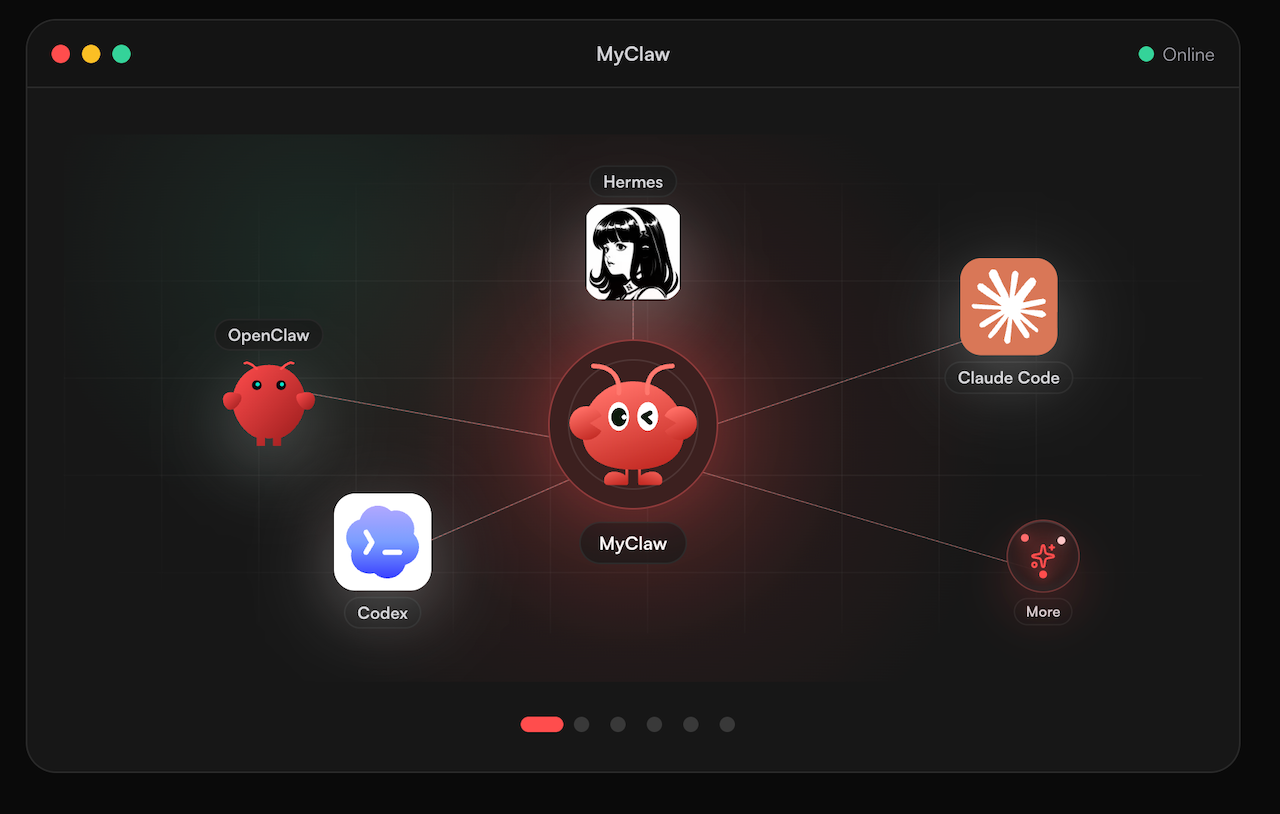
Full stays inside Meta's terminal tool. For an agent that keeps working while you are away, MyClaw keeps your agent (OpenClaw or Hermes) running around the clock, with Muse Spark available as its model. Our OpenClaw model picks and the OpenClaw primer cover the setup choices.
- Create a MyClaw account and choose OpenClaw or Hermes for your new agent.
- Select Muse Spark as the model in the agent's settings.
- Give the agent its first recurring task, and finally connect your chat app to get its updates.
Skip the Setup, Run Best-in-Class AI Agents Now
Launch a managed OpenClaw or Hermes Agent workspace in minutes, with always-on hosting, updates, and support handled by MyClaw.