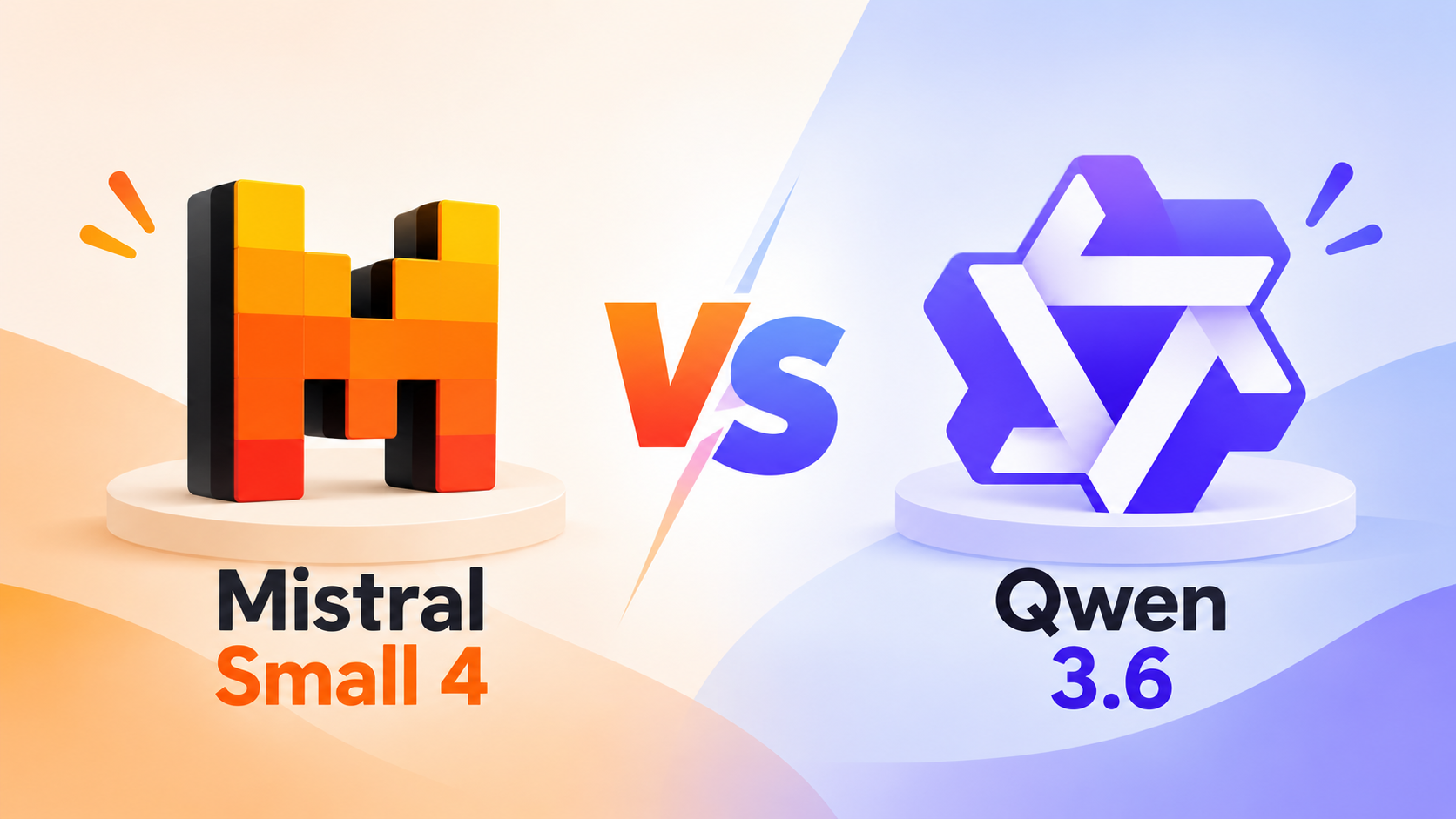
Mistral Small 4 vs Qwen 3.6: 27B Dense, 35B MoE and Which to Run

By Olivia Hart
MyClaw Editorial
MyClaw
Run Best-in-Class AI Agents Now
Run OpenClaw or Hermes Agent on managed MyClaw hosting, so your AI agent stays online, updated, and ready for real work.
AI Takeaway
- Should I choose Mistral Small 4 or Qwen 3.6?On published numbers Qwen 3.6 is stronger: both the 27B and 35B-A3B versions beat Small 4 on GPQA Diamond and rank well above it on Artificial Analysis's index, while Small 4 wins on API price, output speed and brevity.
- What is the difference between Qwen 3.6 27B and 35B?Qwen3.6-27B is a dense model that uses all 27B parameters on every token, while Qwen3.6-35B-A3B is a mixture-of-experts model that activates about 3B of its 35B per token, giving up a little accuracy for much faster generation.
- Which is cheapest on the vendors' own APIs?Small 4 costs $0.15 input and $0.60 output per 1M tokens on Mistral's API, while Alibaba Cloud's international Model Studio charges $0.375/$2.25 for Qwen3.6-35B-A3B and $0.60/$3.60 for Qwen3.6-27B.
- Which is easier to run on my own hardware?Qwen 3.6 by a wide margin, because 27B or 35B weights are a fraction of Small 4's 119B, which Mistral says needs at least a multi-GPU server.
- Are all three free for commercial use?Yes, Mistral Small 4, Qwen3.6-27B and Qwen3.6-35B-A3B are all released under the Apache 2.0 licence.
Three Models, Two Families
This matchup is really one Mistral model against two Qwen siblings that take opposite design paths.
Mistral Small 4 launched on March 16, 2026 under the API ID mistral-small-2603. Its mixture-of-experts design uses 128 experts, four of them active per token, for 119B total parameters and roughly 6.5B in use at a time. Mistral built it to replace three specialist lines at once, and a reasoning_effort setting switches step-by-step thinking on or off per request. Our Small 4 vs Large 3 comparison covers how it sits inside Mistral's own lineup.

Qwen3.6-27B arrived in April 2026, and Qwen's own model card headlines it as flagship-level coding in a dense model. All 27B parameters fire on every token. Its 64 layers mix Gated DeltaNet linear attention with standard gated attention in a 3-to-1 pattern, and a vision encoder handles images.
Qwen3.6-35B-A3B came out the same month. It uses the same hybrid attention design across 40 layers, but swaps the dense feed-forward blocks for 256 experts, routing each token to eight of them plus one shared expert. That leaves about 3B parameters active per token.
Both Qwen models support thinking and non-thinking modes, and add a "thinking preservation" option that carries earlier reasoning into later turns, useful for long coding sessions. Alibaba also sells a hosted Qwen3.6-Plus with no open weights, which this guide sets aside, and its pricing page now lists newer Qwen 3.8 models too. For how the two open Qwen variants fare against a large DeepSeek model, see our DeepSeek V4 Flash and Qwen 3.6 guide.
Spec Table: Small 4, Qwen 3.6 27B and 35B-A3B
Sources: Mistral's docs plus the official Qwen model cards (both read on Oct. 14, 2026).
| Spec | Mistral Small 4 | Qwen3.6-27B | Qwen3.6-35B-A3B |
|---|---|---|---|
| Released | March 16, 2026 | April 2026 | April 2026 |
| Licence | Apache 2.0 | Apache 2.0 | Apache 2.0 |
| Design | Mixture of experts | Dense | Mixture of experts |
| Total parameters | 119B | 27B | 35B |
| Active per token | About 6.5B | 27B | About 3B |
| Context window | 256K | 262,144 tokens natively; roughly 1.01M when extended | Same as 27B |
| Accepted inputs | Text, image | Text, image | Text, image |
| Reasoning control | reasoning_effort: none or high | Thinking or non-thinking mode | Thinking or non-thinking mode |
| Serving stacks named | vLLM, SGLang, llama.cpp, Transformers | Transformers, vLLM, SGLang, KTransformers | Same as 27B |
Active parameters drive speed, not memory. Small 4 computes with only 6.5B parameters per token, yet all 119B must still be loaded, which is why it needs far more hardware than either Qwen model.
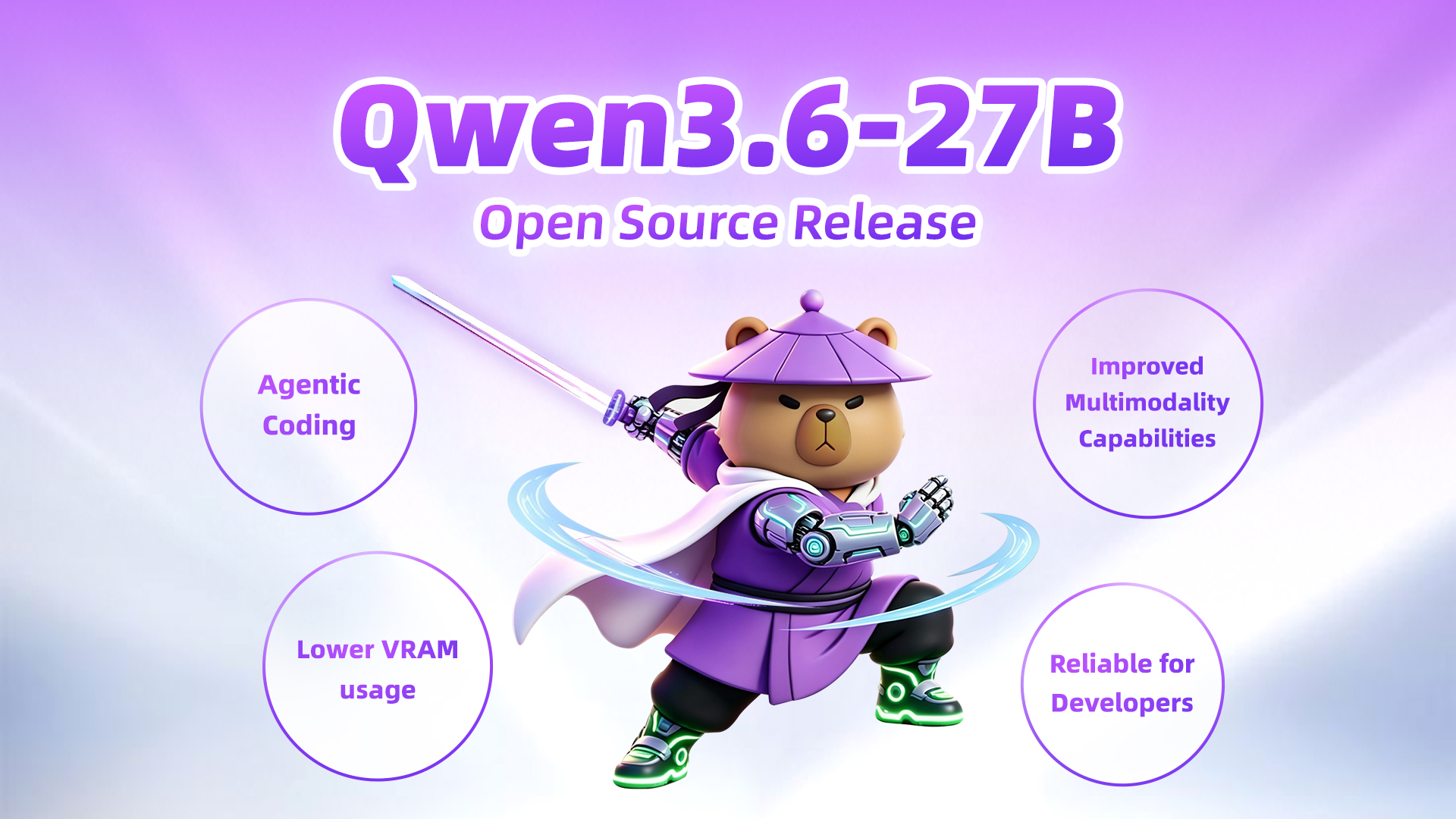
Benchmarks: Vendor Tables and an Independent Index
Overlapping Vendor-Reported Rows
Mistral and Qwen run their own evaluations with different harnesses, settings and sometimes benchmark versions, so direct comparisons are rough at best.
| Benchmark (vendor-reported) | Small 4 (reasoning) | Qwen3.6-27B | Qwen3.6-35B-A3B |
|---|---|---|---|
| GPQA Diamond | 71.2 | 87.8 | 86.0 |
GPQA Diamond is the only row we could confirm in Mistral's published model-card data. Mistral otherwise reports Small 4 against GPT-OSS 120B in charts, saying it matches or beats that model on LiveCodeBench while writing about 20% less. Qwen reports 83.9 (27B) and 80.4 (35B-A3B) on LiveCodeBench v6.
Qwen-Only Agent Rows (27B vs 35B)
Qwen publishes agentic coding results that Mistral does not match for Small 4:
| Benchmark (Qwen-reported) | Qwen3.6-27B | Qwen3.6-35B-A3B |
|---|---|---|
| SWE-bench Verified | 77.2 | 73.4 |
| SWE-bench Pro | 53.5 | 49.5 |
| Terminal-Bench 2.0 | 59.3 | 51.5 |
| MMLU-Pro | 86.2 | 85.2 |
The dense 27B leads its MoE sibling on every row, with the widest gap on terminal tasks.
Artificial Analysis (Third-Party)
| Artificial Analysis result (read Oct. 14) | Small 4 | Qwen3.6-27B | Qwen3.6-35B-A3B |
|---|---|---|---|
| Intelligence Index (reasoning variants) | 11 | 21 | 18 |
| Output speed | ~165 tokens/sec | ~58 tokens/sec | ~133 tokens/sec |
| Tokens written across the index run | 54M | 160M | 160M |
The independent picture matches the vendor tables: both Qwen models score far higher, but each writes about three times as many tokens as Small 4 to get there. Our review pitting Ling 3.0 Flash against the 27B digs further into the 27B's speed trade-off.
Pricing on First-Party APIs
Per 1M tokens, as each vendor listed them on October 14, 2026:
| Model and vendor | Input | Output |
|---|---|---|
| Mistral Small 4 (Mistral API) | $0.15 | $0.60 |
| Qwen3.6-35B-A3B (Alibaba Model Studio, international) | $0.375 | $2.25 |
| Qwen3.6-27B (Alibaba Model Studio, international) | $0.60 | $3.60 |
Alibaba charges the same output rate in thinking and non-thinking mode. Its Beijing region is cheaper, at $0.248/$1.485 for the 35B-A3B and about $0.41/$2.48 for the 27B, and the Singapore region alone includes a free quota of 1M tokens per model, valid for 90 days. On Mistral's side, batch jobs are half price and repeated prompt prefixes can be up to 90% cheaper.
Our arithmetic for 1,000 jobs, each reading 20K tokens and writing 2K: roughly $4.20 with Small 4, $12.00 on Qwen3.6-35B-A3B and $19.20 on Qwen3.6-27B. Because the Qwen models produce far longer answers when thinking, real bills widen that gap further.
Self-Hosting: Where Qwen Pulls Ahead
For Small 4, Mistral's stated floor is a 4× HGX H100, 2× HGX H200 or single DGX B200 setup. That is data-centre hardware.
Qwen does not publish hardware minimums, but size tells the story. By our arithmetic, at 16-bit precision the weights alone are about 54 GB for the 27B and about 70 GB for the 35B-A3B, before any context cache; 4-bit quantization cuts that to roughly a quarter. Quantized builds of either model are within reach of a single high-memory workstation GPU, though real limits depend on context length and serving stack, and the 35B-A3B's 3B active parameters help keep it responsive.
Qwen's recommended sampling differs by mode: temperature 0.6 and top_p 0.95 when thinking, temperature 0.7 and top_p 0.8 otherwise. For another view of local Qwen against an open Google model, see how Qwen 3.6 fares against Gemma 4.
Which Model to Pick
| Situation | Best fit |
|---|---|
| Cheapest high-volume API calls | Mistral Small 4 |
| Strongest coding and agent accuracy | Qwen3.6-27B |
| Fast agent on a single local GPU | Qwen3.6-35B-A3B |
| Long multi-turn coding with reasoning carried over | Either Qwen model |
| Existing Mistral stack or EU vendor preference | Mistral Small 4 |
Mistral Small 4
Pros: lowest first-party API price, fastest output, concise answers, one endpoint for chat and reasoning.
Cons: much lower independent index score, 119B weights need data-centre GPUs, few published benchmarks to compare against.
Qwen3.6-27B
Pros: highest scores of the three, strong SWE-bench and Terminal-Bench results, dense design is predictable to serve.
Cons: slowest generation, most expensive on Alibaba's API, very verbose when thinking.
Qwen3.6-35B-A3B
Pros: close to the 27B on most rows, fast thanks to 3B active parameters, easy to run locally.
Cons: trails the 27B on agent tasks, still verbose, pricier than Small 4 per token.
Verdict: Qwen for Capability, Small 4 for Cheap Throughput
Pick Qwen3.6-27B when accuracy on coding and agent work matters most, and Qwen3.6-35B-A3B when you want most of that quality at local, interactive speed. Pick Mistral Small 4 for high-volume API traffic where short, cheap answers beat peak scores. Whichever you lean toward, run a week of your real prompts through each before committing, because vendor charts rarely match production traffic. For a ranking across many more models, see our guide to the top models for OpenClaw.
Keep an Agent on Duty Nonstop With MyClaw
A good model only pays off when an agent keeps using it. MyClaw hosts the agent for you, so nothing depends on your laptop staying awake.
- Start a MyClaw account and decide between OpenClaw and Hermes Agent.
- Pick a model from the built-in list. Next, connect your chat app; answers arrive there.
- Schedule one repeating job and check the results each morning.
Unsure what the agent does? Read our OpenClaw primer.
Skip the Setup, Run Best-in-Class AI Agents Now
Launch a managed OpenClaw or Hermes Agent workspace in minutes, with always-on hosting, updates, and support handled by MyClaw.