GPT-6.1 Terra vs 5.6 Terra: Each Setting Beats Two Steps Up

By Olivia Hart
MyClaw Editorial
Compare in MyClaw
Compare GPT-6.1 Terra and GPT-5.6 Terra on your own work
Give both models the same task and compare quality, speed, and cost.
AI Takeaway
- Does GPT-6.1 Terra score higher at the same effort? Yes, by 6 to 12 Index points at every setting, from none to max (Artificial Analysis, measured Oct. 27, 2026).
- Is it safe to drop two effort levels after upgrading? Yes. 6.1 Terra low scores 36 and 5.6 Terra high scores 34 (Artificial Analysis, measured Oct. 27, 2026).
- How much less does the new setting spend? 6.1 high scores 44 at $0.13 a task. 5.6 max scores 42 at $1.40 (Artificial Analysis, measured Oct. 27, 2026).
- Does GPT-5.6 Terra still win anywhere? Yes. It streams 1.2 to 1.5x faster and starts sooner at none, high and max (Artificial Analysis, measured Oct. 27, 2026).
- Where can I test a swap on real jobs? To test a swap, MyClaw agents run scheduled jobs on most popular models. Try one repeating job on both setups.
GPT-6.1 Terra vs 5.6 Terra: Specs and Rates at a Glance
The 5.6 version of Terra shipped July 9, 2026. The 6.1 version arrived October 26. Vendor-stated figures below, from OpenAI's model docs and announcement posts (checked Oct. 27, 2026).
- Shared: a 1.05M-token context window, 922K tokens of input, a 128K output limit, text and image input, and six effort settings from none to max. Medium is the default on both.
- Standard rates: Per 1M tokens, 6.1 costs $1 for input and $5 for output. 5.6 costs $2 and $12. 5.6 launched at $2.50 and $15, then took a 20% cut on July 30.
- Caching: cache reads cost $0.05 on 6.1 and $0.20 on 5.6. Writes cost $1.25 and $2.50.
- Other tiers: Batch is half price on both. Fast mode costs $2 and $10 on 6.1, and $4 and $24 on 5.6.
- Long prompts: past 272K input tokens, both reprice the whole request: input bills at double and output at 1.5x.
OpenAI says 6.1's standard prices run 50% below 5.6's (OpenAI, stated October 26, 2026). Input and cache writes match that. Output is 58% below and cache reads are 75% below (our arithmetic).
Example (our arithmetic): 200K tokens in, 150K of them cache reads, plus 20K out costs about $0.16 on 6.1 and $0.37 on 5.6.
Related reads: the Terra review and Luna against GPT-5.6 Terra.

GPT-6.1 Terra vs 5.6 Terra: Index, Spend and First Token by Setting
Artificial Analysis (AA) scores every effort setting separately, so each 6.1 level has a 5.6 counterpart. The table shows score, spend and first-token wait.
Independent (Artificial Analysis, checked October 27, 2026):
| Effort | Intelligence Index (6.1, 5.6) | Spend per task (6.1, 5.6) | First token (6.1, 5.6) |
|---|---|---|---|
| None | 33 / 21 | $0.11 / $0.14 | 1.12s / 0.77s |
| Low | 36 / 27 | $0.05 / $0.14 | 1.29s / 1.57s |
| Medium | 41 / 30 | $0.10 / $0.18 | 1.43s / 1.50s |
| High | 44 / 34 | $0.13 / $0.34 | 6.78s / 2.66s |
| Xhigh | 45 / 38 | $0.19 / $0.63 | 17.50s / 29.72s |
| Max | 48 / 42 | $0.40 / $1.40 | 131.81s / 111.75s |
AA's spend is a mean over its test tasks, so real bills vary. "None" is AA's non-reasoning page. AA now tests 5.6 Terra only on its default 10K-token workload, so those figures are frozen.
The same-effort lead for 6.1 is 12, 9, 11, 10, 7 and 6 points, none to max (our arithmetic). It shrinks as effort rises.
For the next tier up, see Terra and Sol side by side.
GPT-6.1 Terra vs 5.6 Terra: The Two-Step Rule
Pair each 6.1 setting with the 5.6 setting two steps higher (our arithmetic, using the table):
- 6.1 none vs 5.6 medium. 33 beats 30. Spend is $0.11 against $0.18. First token: 1.12s against 1.50s.
- 6.1 low vs 5.6 high. 36 beats 34. Spend is $0.05 against $0.34, 6.8x less. First token: 1.29s against 2.66s.
- 6.1 medium vs 5.6 xhigh. 41 beats 38. Spend is $0.10 against $0.63, 6.3x less. First token: 1.43s against 29.72s.
- 6.1 high vs 5.6 max. 44 beats 42. Spend is $0.13 against $1.40, 10.8x less. First token: 6.78s against 111.75s.
The rule: on upgrade, drop two levels and keep the score. Nothing on the old ladder matches 6.1 xhigh (45) or max (48).
Now test OpenAI's claim. It reports a 15-point gain at medium on Agents' Last Exam for a third of the spend (OpenAI, stated October 26, 2026). That is a different test. On AA's Index, medium spends 56% of the 5.6 figure ($0.10 against $0.18).
GPT-6.1 Terra vs 5.6 Terra Cost: The Spend Gap Grows With Effort
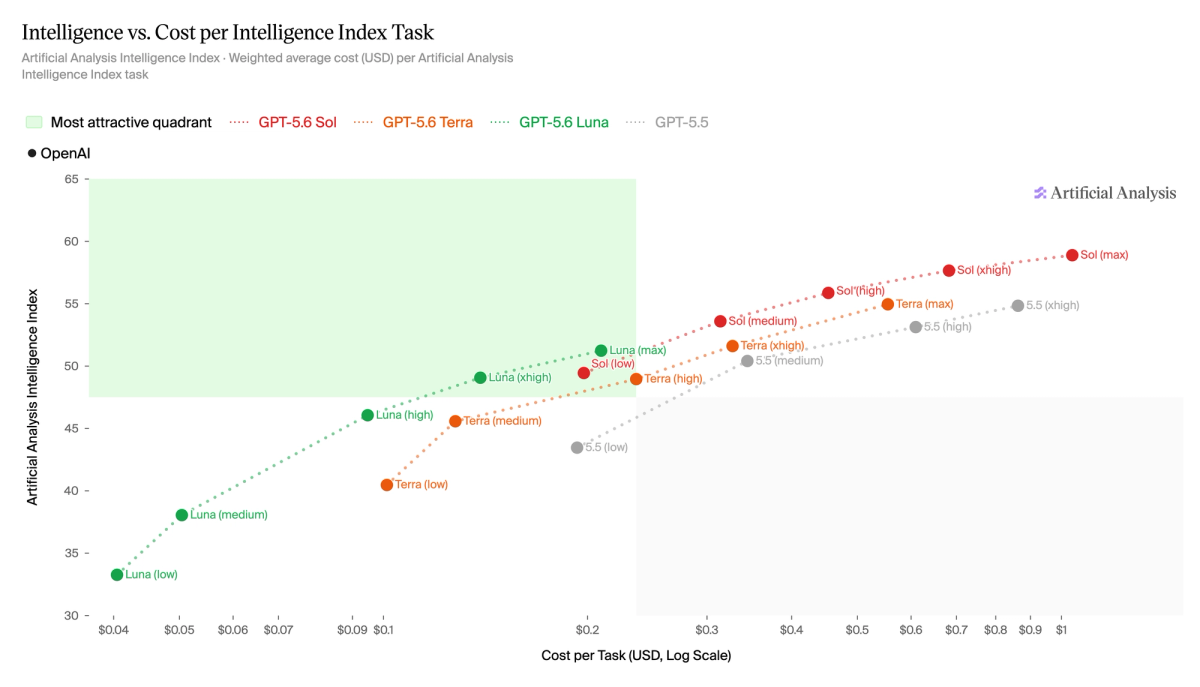
The same-effort spend ratio, 5.6 over 6.1, runs 1.3x at none, 2.8x at low, 1.8x at medium, 2.6x at high, 3.3x at xhigh and 3.5x at max (our arithmetic). It is uneven but widens toward the top.
6.1 also writes fewer tokens, up to a point. AA counts 7.9M, 14M, 23M and 41M output tokens at low through xhigh. 5.6 writes 11M, 17M, 33M and 52M. That is 18% to 30% fewer. At max the order flips: 130M for 6.1 and 120M for 5.6 (AA, checked October 27, 2026).
Rates alone do not explain the gap. At max, 6.1 writes 8% more tokens yet spends 3.5x less. Output rates alone would give 2.2x, so lower input and cache rates likely carry the rest. At medium it runs the other way: rates and tokens point to 2.9x, but AA shows 1.8x. AA does not split spend by token type, so this is our reading. Run the swap on real traffic first, before quoting any savings figure.
For a pricier rival, see Terra against Opus 5.5.
GPT-6.1 Terra vs 5.6 Terra Speed: Where the Older Model Still Wins
Independent (Artificial Analysis, checked October 27, 2026):
- Streaming: 5.6 Terra runs 112.7 to 135.4 tokens per second across efforts. 6.1 Terra holds near 91 at every setting. That makes 5.6 faster by 1.2x to 1.5x (our arithmetic).
- First token: 5.6 starts sooner at none (0.77s against 1.12s), at high (2.66s against 6.78s) and at max (111.75s against 131.81s). 6.1 starts sooner at low (1.29s against 1.57s) and xhigh (17.50s against 29.72s). Medium is a near tie, 1.43s against 1.50s.
Third-party (OpenRouter, checked October 27, 2026): the two models overlap. Latency ran 1.85s to 2.41s for 6.1 and 1.95s to 3.74s for 5.6. Throughput ran 59 to 100 tokens per second for 6.1 and 63 to 97 for 5.6. Figures moved between checks. Read them as a range, not a ranking.
Access differs too (OpenAI, checked October 27, 2026). Its help center lists GPT-5.6 Terra for Free and Go users in Codex. Its pricing page names five plans for GPT-6.1 Terra: Business, Edu, Enterprise, Plus and Pro. Free and Go are absent.
GPT-6.1 Terra vs 5.6 Terra: Which to Run for Which Job
- Any 5.6 Terra job: move it to 6.1 and drop two effort levels. You keep the score and cut the spend.
- Volume work: 6.1 low or medium, scoring 36 to 41 at $0.05 to $0.10 a task.
- Everyday quality: 6.1 high, at 44 for $0.13 a task.
- Latency-bound high effort: 5.6 high can still win the first-token wait, 2.66s against 6.78s. Time your own runs first.
- Max on either: offline jobs only. The first token takes 112s to 132s.
If 48 is not enough, read Terra against Sonnet 5.5 by effort or the GPT-6.1 Sol review.
Test the Swap on a MyClaw Agent
Averages give a first guess. Your own jobs settle it.
With MyClaw, OpenClaw and Hermes come as a managed service, so setup and upkeep are handled. Your agent is always on. It runs scheduled jobs after you log off. You build and patch no server. Any agent you deploy works with most popular models.
- Choose a repeating job, such as a weekly summary or a form-filling routine.
- Run it twice with one prompt: on your current setup, and on the new model two effort levels lower.
- After a week, compare answers kept, retries needed and time to finish.
Keep the setup that clears your bar.
GPT-6.1 Terra vs 5.6 Terra Verdict
- Upgrade to 6.1 Terra. It scores higher at every setting.
- Drop two effort levels and keep the score. Spend falls 1.6x to 10.8x.
- Keep 5.6 Terra only where first-token or streaming speed decides the job, or your plan offers nothing newer.
- Reserve max for work that can wait.
Move one job first, check the score and the wait, then move the rest.
Compare in MyClaw
Compare GPT-6.1 Terra and GPT-5.6 Terra on your own work
Give both models the same task and compare quality, speed, and cost.