Best Flowise AI Alternatives in 2026 (After Sunset)

By Emma Reed
MyClaw Editorial
MyClaw
Run Best-in-Class AI Agents Now
Run OpenClaw or Hermes Agent on managed MyClaw hosting, so your AI agent stays online, updated, and ready for real work.
AI Takeaway
- What are the best Flowise AI alternatives after the sunset? Langflow for the closest open-source visual canvas, Dify for production RAG and AI apps, n8n when AI sits inside broader automation, LangGraph for code-first stateful agents, and MyClaw for a managed always-on OpenClaw or Hermes agent instead of another builder.
- Is there a free or open-source Flowise alternative? Yes. Langflow is the closest MIT self-host swap; Dify and n8n also self-host under their own license terms. Forking archived Flowise is possible, but you own maintenance afterward.
- Does MyClaw replace Flowise’s visual builder? No. MyClaw hosts private always-on OpenClaw and Hermes agents—useful when you want the agent online without another node graph, not a drag-and-drop LangChain UI.
- Why are teams leaving Flowise now? Official freeze, archive, and end of support mean new projects should not start on Flowise. Teams move for active maintenance, production RAG, system integrations, or a runtime that stays up without a canvas.
- How should you choose among Flowise alternatives? Match the job: visual LLM builder, AI product platform, automation with AI steps, orchestration in code, or a persistent agent with managed hosting.
Why Teams Look for Flowise Alternatives Now
Flowise officially froze features around 2026-07-29, archived the GitHub repository around 2026-08-13, and reached end of official support around 2026-08-31. The Apache 2.0 core remains forkable, but npm and Docker distributions are deprecated and there is no official core maintenance path.
New projects should not start on Flowise. Use the glance table and How to Choose section below to map each option to a job—visual builder, AI product platform, automation with AI steps, code-first graph, or managed always-on agent hosting.
Flowise AI Alternatives Compared at a Glance
| Alternative | Best For | Type | Free / OSS Path | Main Tradeoff |
|---|---|---|---|---|
| MyClaw | Always-on private agent without DevOps | Managed OpenClaw / Hermes hosting | Paid managed; open runtimes underneath | Not a visual Flowise-style canvas |
| Langflow | Closest visual open-source swap | Visual LLM / agent builder | MIT; free to self-host | You still operate the stack |
| Dify | Production RAG and AI apps | Low-code AI app platform | Self-host with license caveats | Platform constraints vs full code control |
| n8n | AI inside broader business automation | Workflow automation | Self-host (fair-code / source-available) | Stronger at process than conversational agents |
| LangGraph | Stateful code-first agents | Framework / library | Library free; managed platform separate | Requires engineering ownership |
Pick by job, not by chasing feature-count parity with Flowise. If you are still comparing builder stacks versus frameworks, our LangChain alternatives guide covers that adjacent decision.
1. MyClaw — Best for Always-On Agents Without Another Canvas
Best fit: Recurring research, monitoring, inbox or file work, marketing digests, and coding assist—work where the path can change between runs and you need uptime, channels, skills, and schedules more than another node graph.
Pros:
- Managed OpenClaw or Hermes hosting keeps a private agent online with updates, backups, and isolation handled for you
- Skills and messaging channels live in one workspace, so the agent keeps working after you close the tab—without a Flowise-style canvas to maintain
Cons:
- MyClaw is not a node-based LLM orchestrator and not a Flowise or Langflow drop-in
- Engineers who need custom graphs, inspectable flows, or an embeddable SDK should choose LangGraph, Dify, or Langflow instead
Selection context: Choose MyClaw when you are leaving Flowise because you wanted an agent that keeps working—not another prototype canvas. Skip it if the deliverable must remain a designed, inspectable flow graph.
How to Run an Always-On Agent on MyClaw
- Launch a managed OpenClaw or Hermes workspace. Pick a plan that matches CPU, RAM, and storage needs. Hosting is separate from model tokens—confirm live details on MyClaw pricing.
- Define one concrete job. Connect the channels and tools that job needs, then set the expected result, schedule, and approval boundary—for example, a weekly competitor brief with sources.
- Schedule and improve from evidence. Put the loop on a rhythm, review failed runs, and add skills only after the first job is reliable.
2. Langflow — Closest Open-Source Visual Replacement
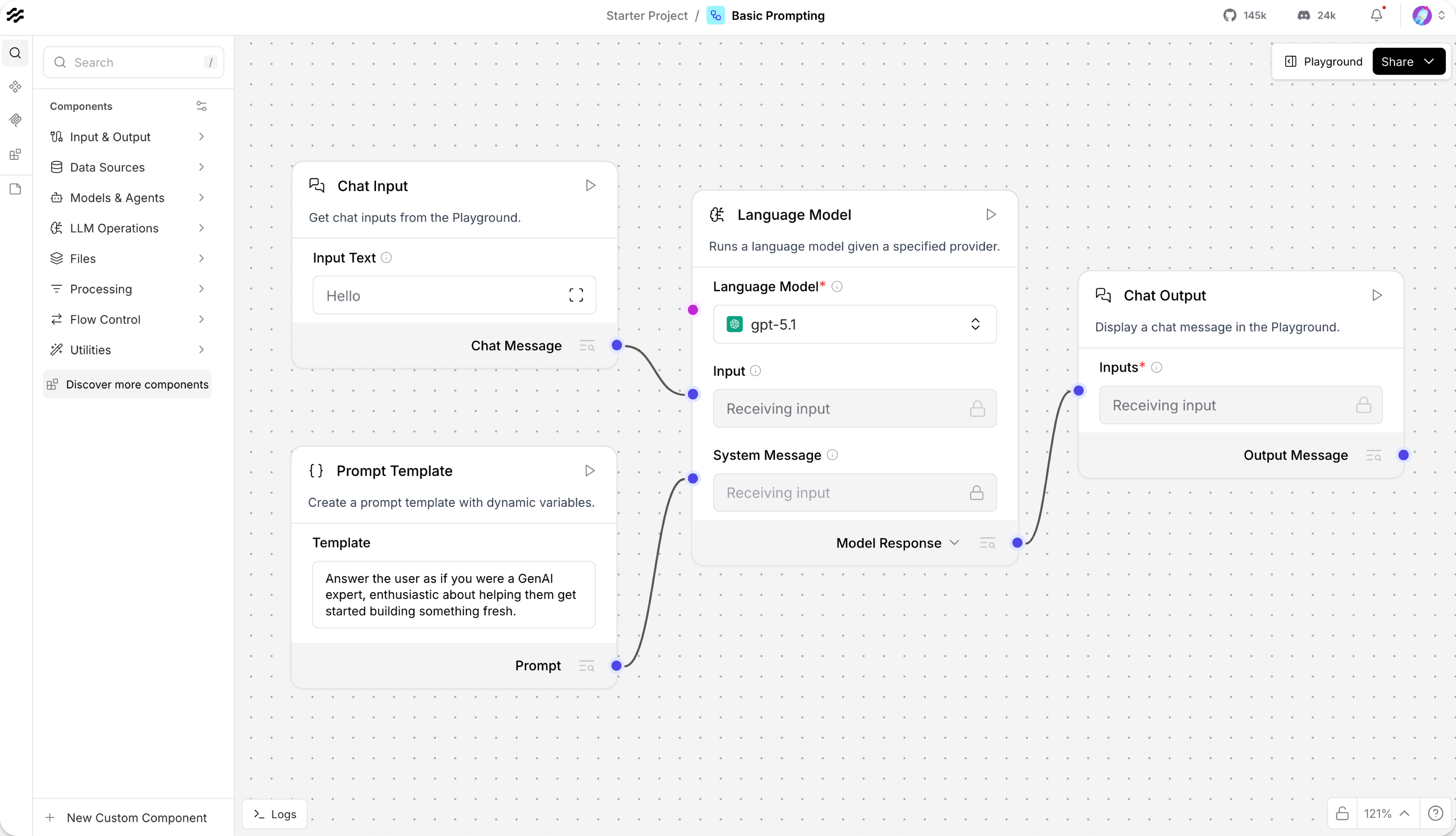
Best fit: Teams that liked Flowise’s drag-and-drop LLM graph and want an actively maintained MIT canvas with similar muscle memory.
Pros:
- Visual components, playground testing, self-host deployment, and a Python escape hatch when a node is not enough
- For “replace the canvas,” Langflow is usually the first stop
Cons:
- You still operate updates, auth, scaling, and observability
- Langflow is a builder you run—not a managed personal agent that stays online for you
Selection context: Choose Langflow when the Flowise habit was designing and debugging flows on a canvas. Expect a rebuild: Flowise JSON is not Langflow JSON, so plan regression tests before you cut over.
3. Dify — Best for Production RAG and AI Apps
Best fit: Chatbots, knowledge apps, and internal assistants that need retrieval, logging, team features, and a deployable app surface—not only a prototype chain.
Pros:
- Native RAG, app-facing surfaces, and an ops-minded console, with cloud or self-host options
- It feels closer to shipping a product than wiring another experimental graph
Cons:
- Self-host and commercial use carry license caveats you should read carefully
- Dify is more platform than freeform graph, and it is not managed always-on OpenClaw-style agent hosting
Selection context: Prefer Dify when your Flowise flows were really products—customer or employee-facing AI apps with knowledge bases—rather than short-lived experiments.
4. n8n — Best When AI Is One Step Inside Broader Automation
Best fit: Triggers, CRM or Slack steps, HTTP calls, approvals, and schedules—with an LLM call in the middle of a durable business process.
Pros:
- Hundreds of integrations, cloud or self-host paths, and strong process control when the hard part is connecting systems rather than designing a conversational agent studio
Cons:
- n8n is automation-first. It is weaker as a multi-agent conversation canvas, and self-host operations remain yours if you leave the cloud plan
Selection context: Choose n8n when Flowise graphs were mostly connectors plus a model call. Prefer MyClaw or a dedicated agent runtime when the job is recurring research or marketing work rather than ticket-to-CRM plumbing.
5. LangGraph — Best Code-First Path Beyond the Canvas

Best fit: Engineers who need explicit state, branching, retries, checkpoints, and human-in-the-loop control in code rather than on a visual board.
Pros:
- Durable graphs, production-grade control, and an MIT library many teams move to after visual builders stop scaling with product complexity
- You own the orchestration logic instead of fighting a canvas abstraction
Cons:
- Steeper than a drag-and-drop builder. Deploy, observability, and recovery are yours unless you add a separate managed platform
- For peers and managed options, see LangGraph alternatives. Role-based multi-agent teams may fit a CrewAI path better than a low-level graph
Selection context: Choose LangGraph when leaving Flowise means graduating from prototypes to engineered agent products—not when you only need another visual editor.
Free and Open-Source Flowise Alternatives
For a free self-host visual path, Langflow is the closest honest answer. Dify and n8n also offer self-host routes, each with license and fair-code terms you should verify before commercial deployment. LangGraph’s library is free; a managed LangGraph platform is a separate decision. Forking archived Flowise can buy time, but you inherit security patches, dependency drift, and on-call work with no upstream.
Free is not zero cost. Servers, embeddings, model APIs, and operator time still show up on the bill. Budget a migration week for prompt parity, connector auth, and failure modes you used to ignore in a prototype canvas. MyClaw is not a free open-source builder—it is paid managed hosting on open agent runtimes when you want to remove that ops load and keep one private agent online without babysitting Docker.
If your team only needs temporary continuity while you pick a destination, a Flowise fork can bridge a sprint. Treat that bridge as disposable: pin dependencies, freeze new features, and schedule the cutover so you do not inherit an unmaintained visual builder as permanent infrastructure.
How to Choose the Right Flowise Alternative
- Still need a visual LLM canvas: Langflow first; Dify if the app and RAG surface matter more than pure graph freedom.
- AI as one step inside ops: n8n.
- Custom stateful product logic in code: LangGraph.
- Always-on assistant without DevOps: MyClaw.
Start one real workload for a week. Compare build time, failed runs, and ops load—not feature checklists. When the bottleneck is uptime and ownership rather than another flow editor, launch a managed OpenClaw or Hermes workspace and confirm plan details on pricing.
The best Flowise AI alternative depends on the job you need to run. MyClaw leads when that job is a private agent that stays online; Langflow, Dify, n8n, and LangGraph win on their home turf. Pick the category that matches the work, then prove it on one concrete task before you migrate everything.
Skip the Setup, Run Best-in-Class AI Agents Now
Launch a managed OpenClaw or Hermes Agent workspace in minutes, with always-on hosting, updates, and support handled by MyClaw.